

Democrats are finally doing something they should have started a decade ago: building their own media ecosystem. After years of watching Republicans dominate the information battlefield – from talk radio to Fox News to an online universe of influencers and podcasters ready to amplify the right’s messaging within minutes – Democrats have begun assembling their own constellation of progressive podcasts, YouTube shows, and digital creators. MeidasTouch, highly produced political TikToks, and a newly professionalized Democratic creator class represent the first serious attempt to match the right’s communication infrastructure. But the faces elevated as the symbols of this new ecosystem look alarmingly familiar: overwhelmingly white, often male, and deeply unreflective of the multiracial coalition Democrats need to win.
A recent Washington Post report unintentionally spotlighted this problem. In profiling the party’s most prominent online voices – the Meiselas brothers, Heather Cox Richardson, Brian Tyler Cohen, Jennifer Welch, Angie Sullivan, and Aaron Parnas – the piece showcased a dynamic Democrats should recognize as a flashing red warning. Not one Black, brown, or even tan face. In fact, the emerging left-wing media ecosystem looks a lot like the old legacy media environment Democrats spent years criticizing.
Despite its freshness, its edginess, and its internet-native style, the new Democratic megaphone is still overwhelmingly driven by non-diverse voices. The major shows with the biggest audiences, the largest financial backing, and the most reliable amplification pipelines are dominated by white, often male hosts.
There is no shortage of diverse creators on the left, there are thousands of Black, Latino, Asian American, and immigrant voices producing smart political content every day. The issue is that the biggest progressive platforms (the ones Democratic campaigns and powerbrokers instinctively turn to) rarely elevate these creators into positions of equal visibility or influence.
This is not a DEI scolding or a “woke” complaint. This is an electoral warning. Democrats cannot afford to build a media ecosystem that does not look like the coalition they need to win. Messenger identity matters – not because voters demand it for moral reasons, but because trust, cultural fluency, and narrative resonance are shaped by lived experience. Given major 2024 losses with key demographics like Latinos, we have just seen what happens when Democrats fail to speak with, not just at, the communities they rely on. Studies have found that audiences are more likely to trust information delivered by someone who shares their demographic background. Democrats ignore that reality at their peril.
Media is an oligopolistic industry. While social media platforms and the ability to go viral have democratized new media to some degree, in practice only a small handful of outlets ever accumulate the scale, attention, and revenue needed to set the narrative. Everyone else ends up orbiting around them.
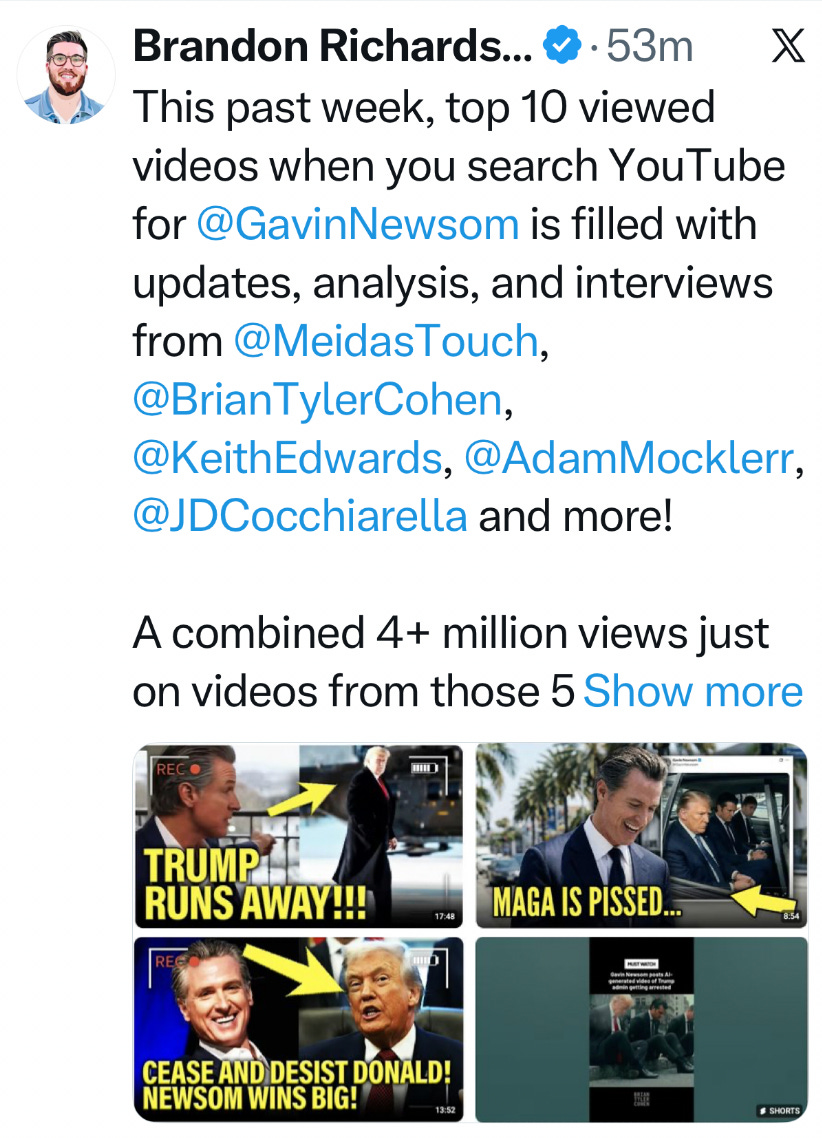
Democratic politicians and powerbrokers are increasingly turning to new media outlets but naturally seek out the biggest liberal podcasts and YouTube channels. The effect is that they are overwhelmingly elevating the same narrow group of hosts. Power is quickly consolidating among a small, homogenous set of channels that act as gatekeepers: a handful of massive progressive platforms dominate distribution, fundraising, and access, while a vast universe of diverse creators remains stuck outside the amplification pipeline. In other words, supply is diverse – but distribution is not. And the distribution is what determines political reach and influence. As we have seen in the past, it appears non-diverse outlets, unsurprisingly, choose to boost voices that look like their own. One need only scan through the most popular Democratically aligned new media Instagram grids to confirm that the outlets almost exclusively posts or collaborates with white creators.
Without intervention, Democrats are about to replicate one of the worst outcomes of the early 2000s legacy media landscape: a tiny circle of non-diverse voices shaping national political narratives, even as the electorate grows more multiracial each year. Republicans don’t have this problem because their coalition is demographically narrower (though even they feature diverse voices like Candace Owens). Democrats, on the other hand, cannot build a winning media machine on top of the myopathy they claim to be correcting with their policy agenda.
The left’s creators of color should not be brought on only as special guests or community-specific commentators. They should be co-hosts, anchors, and central partners in the most influential progressive platforms. Donors and party-linked media investors should be directing serious funding to minority-led media talent. Major progressive outlets should be building intentional pipelines to elevate diverse creators, not falling back on the personalities who already have the biggest microphones. Campaigns should be partnering with minority creators early and consistently – not scrambling weeks before Election Day when turnout models start showing slippage in Asian American, Black, or Latino support.
Democrats have finally built the beginnings of the media infrastructure they’ve lacked for decades. But a media ecosystem that does not reflect the voters Democrats need is not a media ecosystem built to win or even endure. There is still time to course correct as the left’s new media infrastructure takes shape, but if diversity remains an afterthought, the imbalance will calcify – and those left ignored will make themselves heard at the ballot box.
Thanks for reading! For more of my work subscribe to my personal newsletter and check out my podcast Extremely Reasonable for convos with public officials, candidates, and newsmakers.
Agreed. Share your favorites here so we can all follow them and bring attention to their voices.
Excellent excellent points.