


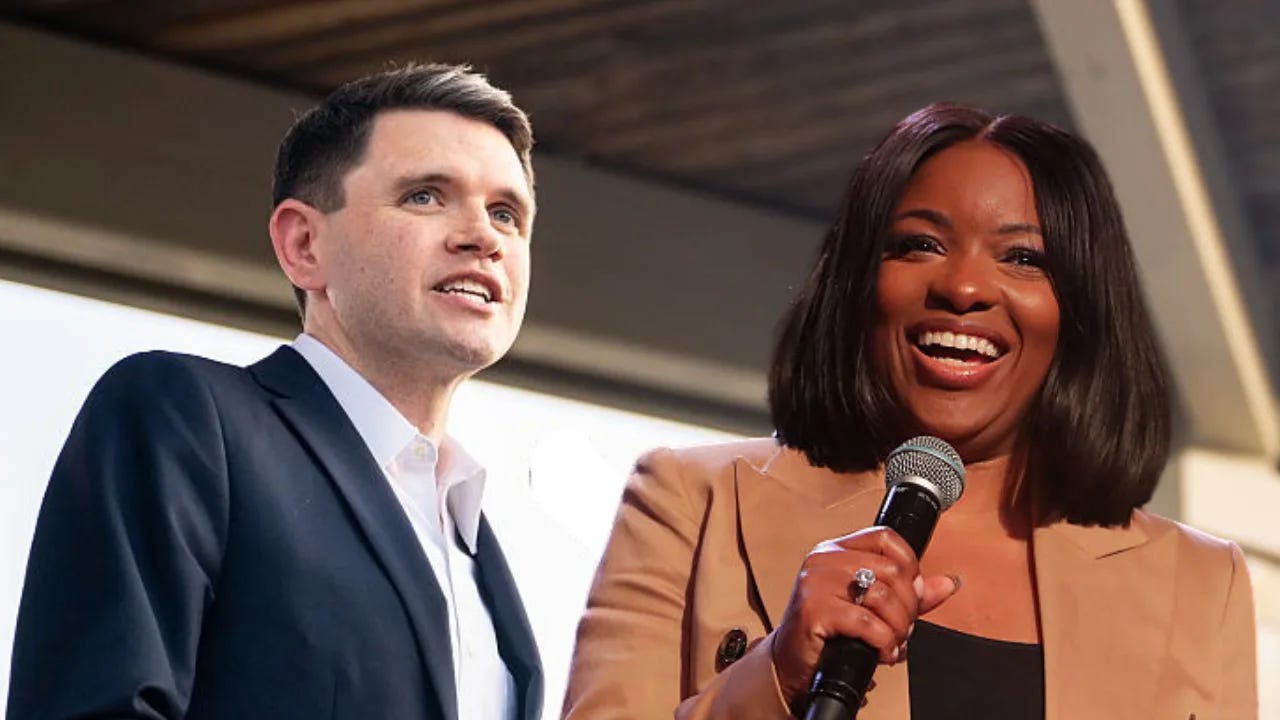
Viral Texas candidate James Talarico’s rise has unfolded under a set of conditions that are unusually punishing for a promising Democratic candidacy. In politics, timing can be everything and in this moment, his message is breaking through as the country appears ready for his pitch of taking on the oligarchy and tamping down Christian nationalism. For the first time in thirty years, Democrats stand a real chance to win statewide in Texas. But a perfect storm has wreaked havoc on the primary race, threatening to derail the party’s chances.
On the substance, Talarico’s timing could hardly be better. His critique of concentrated wealth and his refusal to accommodate Christian nationalism align closely with the political moment. The message travels easily across platforms and audiences, including constituencies Democrats rarely reach, with Talarico famously winning over manosphere voices like Joe Rogan, despite Democrats’ limited success with such figures. Talarico has amassed well over a million followers on Tiktok and across other platforms. In a different context, such a breakout would likely be treated as a collective advantage for a party eager to expand its reach.
Yet, as much as Talarico’s time may have come in terms of message and medium, his primary campaign against Rep. Jasmine Crockett has become a referendum on long-brewing tensions on the left. His campaign is colliding with an overdue reckoning over what some dismissively have labeled “identity politics.” To complicate matters more, the primary dynamic is being supercharged by a nascent new media ecosystem the left has hurriedly built following its 2024 loss. The controversy now surrounding his campaign is not accidental, but inevitable. Texas has become the stage on which Democrats are replaying unresolved arguments about race, gender, media power, and electability.
Since 2016, Democrats have been engaged in a prolonged reckoning over race, gender, and power – one that has resurfaced repeatedly without resolution. Hillary’s loss. Bernie reportedly telling Sen. Warren a woman was unelectable. The devastating return of Trump after the party nominated its first Black woman. For those on the left that buy into 2024 debriefs that blame “wokeism” and a lack of a focus on young men for Harris’s loss the answer is clear: less diversity. Some have come right out to say it. Others intimate it through the language of “electability.”
For a party that routinely credits Black women as the “backbone” of its electoral coalition, the implication is difficult to ignore. Representation is celebrated rhetorically, but often treated as disposable when the stakes rise. A core segment of the base feels Harris and Clinton were abandoned by part of the left unwilling to heed clear warnings from an accomplished woman or Black woman.
Kamala Harris’s loss did not close these debates – it hardened them. They lingered, waiting for the next moment of stress. Jasmine Crockett’s entry into the race lit the match. A Black woman and a rising figure within the party, Crockett entered the contest after redistricting reshaped her political calculus. Her candidacy did not create the tension so much as activate it. Talarico’s momentum, once largely about message and reach, was suddenly interpreted through a lens shaped by years of accumulated grievance and suspicion within the party.
This divide had already been primed by intraparty disputes over Graham Platner in Maine weeks before: another digitally appealing – but controversial – white male candidate that some on the left anointed the party’s future, while targeting his opponent, Janet Mills.
Party discourse has been exacerbated by Democrats’ effort to construct a media ecosystem capable of countering the Right’s online dominance. Since the party’s 2024 loss, candidates and campaign has invested in platforming and engaging political creators and YouTubers. Despite objective improvements in their battle for the internet, the left-wing new media ecosystem that has emerged is narrow in practice. A small set of non-diverse voices exercises disproportionate influence over which candidates are amplified, defended, or framed as emblematic of the party’s future. Talarico has benefited from this attention with white male YouTubers aggressively advocating for him, while criticizing Crockett in ways many found biased. It’s no surprise Talarico may resonate with these other young white male creators. However, as is often the case, a lack of diversity has led to major blindspots. Things got so bad, that shortly after Crockett entered the race, Talarico put out a message calling for his supporters to respect her. His campaign even apparently felt the need to reach out to one such creator to ask them to stop what they viewed as “problematic” posting.
At that point, resistance was nearly inevitable. For Crockett’s supporters, the issue is no longer merely preference or ideology. It appears to reflect a familiar asymmetry: who receives patience, who receives scrutiny, and who is presumed viable from the outset.
That conflict became explicit this week when Colin Allred responded to a viral Tiktok claim that Talarico had called him a “mediocre Black man.” Allred took the opportunity to endorse Crockett and attack Talarico as only getting attention due to white male identity politics, “you’re not saying anything unique – you’re just saying it looking like you do.” Whether one accepts that assessment or not, it clarified what had already become evident. This race was no longer only about Texas.
Much of this lies beyond Talarico’s control. He did not create the party’s unresolved tensions, nor did he design the media ecosystem that now shapes and complicates the conversation. But timing has placed him at their intersection. That has consequences if the party cannot unite behind whoever wins the primary next month.
Talarico may yet weather this perfect storm and emerge as the nominee. The greater danger lies ahead. If Democrats conclude that representation is a liability, that media attention can substitute for coalition-building, and that internal tensions can be deferred rather than addressed head-on, this hard-fought opening in Texas will close just as quickly as it appeared.
I would love to see the Texas Democrats find a way to utilize both of these excellent candidates in representation of the people.
Kaivan,
The American people are facing a full-blown fascist onslaught by their own government that includes employees of rogue, unhinged, reckless, vicious, diabolical federal agencies terrorizing and brutalizing immigrants and refugees of color and intimidating and murdering American citizens attempting to stop them from doing so.
And Democrats still can’t get their shit together. They haven’t come to terms with how their inability to address the Gaza genocide led to millions of Biden’s 2020 voters not voting in 2024 (very unwisely in my judgement).
And they are also fighting over things in Texas, as your column here pointed out, that should be largely irrelevant at this time and may lead to them blowing yet another winnable election.
I sure hope they get their heads out of their asses before it’s too late to save American democracy from the Trump regime’s fascist onslaught.